Category: General

Revalidating an SEP rating by experience

After the licensing review completed by the CAA in October 2025, revalidating a PPL  SEP rating by experience got easier, in one sense, but a little bit

more demanding in another.

Hours required

The old rules were 12 hours flight experience in the second year of validity of the 2 year rating – but bizarrely, none in the first year of validity.

The new requirement is still 12 hours total, but under the new rules these hours can be done over 2 years, which allows more flexibility and the opportunity to spread out the cost of flying. Specifically, the experience requirement over the 2 years is

  • 12 hours total time,
  • of which 6 hours PiC
  • including 12 take offs and landings as sole manipulator of the controls
  • a flight with an instructor of at least 1 hour

The new rules stipulate that at least 6 hours (not necessarily PiC) must be flown in the second year of rating validity, but the other requirements can be met at any time during the 2 years.

The biennial instructional flight

As guidance, the CAA have written GM2, AMC1 and AMC3  to FCL.740.A which can be found on their website here. The aim of the flight is to refresh little-practiced exercises, extend skills, and ensure that flying is safe and competent. There is a lengthy menu of potential topics and exercises  from which we can choose.

Exercises like stalls, steep turns , a practice forced landing and glide or flapless landings would normally be in the mix, as most pilots don’t practice them regularly. The CAA also expect TEM (threat and error management), the use of an MMD (moving map display) such as SkyDemon and partial power-loss scenarios to be covered. Some of these merit a thorough briefing. At my school, we typically do an hour of ground school before the flight itself, which may extend to more than an hour. The briefing often identifies gaps in knowledge, useful exercises, or indeed things the pilot avoids doing through lack of confidence. That’s all grist for the mill.

Other relevant tests

Previously, it was common practice to accept a pass in e.g. an IR or IMC rating revalidation test,  in lieu of the 1 hr SEP instructional flight. It is questionable whether this ever was permitted – the wording in according to the Regulations (FCL.740.A), perhaps badly drafted, suggested that it was not acceptable. To clarify things, the CAA have now stated that the 1 hr instructional flight CAN be combined with an IR or IMCR revalidation test BUT some elements of the SEP instructional flight must be included in that test.

Satisfactory standard

One much debated point is the need to achieve a satisfactory standard – without which the instructor should not sign off the rating revalidation page. In a TrainingCom sent to Instructors and Examiners, available here, the CAA defines ‘satisfactory standard’ as that to be expected during a PPL/LAPL skills test (LST). That has the status of guidance, but the CAA intend to issue further regulatory material as an AMC or GM later in 2026.

You may well ask how the instructional refresher flight differs from a test? In several ways, I think.

  • Firstly, a test is, in principle, a single attempt (pass / fail) for a comprehensive set of exercises without input from the examiner.  In the training flight, the exercises flown may – if necessary – be briefed beforehand, demo’d by the instructor and practiced by the candidate to achieve a satisfactory standard. Bear in mind, though, that a lot of demo and practice, will exceed the 1 hour minimum, but that’s fine – we can plan for that.
  • Secondly, the menu of exercises is not rigid. The flight will invariably comprise some essential safety-related exercises but the content should be tailored to the pilot’s experience, recency and needs. The context of the location may also be relevant. The need to fly accurate headings and altitudes, for example, is paramount in areas close to controlled airspace. Considerations for forced landings and partial power depend on the proximity to airfields and the nature of the landscape being flown over.
  • Thirdly, the flight is not necessarily a one-shot event. It is perfectly OK to do more than one flight and work with the pilot to improve his flying, if needed.
  • Fourthly, a successful test can be logged as PICUS (P1 under supervision). The biennial instruction flight is always logged as PUT.

And finally…..

The flight with an instructor is not (and never has been) a tick-box exercise. A short jolly to have lunch somewhere with your instructor mate won’t cut it. Think what you would like to cover to get best value for money.


LAPL to PPL

Stop Press: effective  1 October 2025, the UK CAA has changed the crediting rules for holders of NPPL(A), NPPL(M) and LAPL(A) licences who wish to ‘upgrade’ to a PPL.  This blog has been updated with the latest rules.

After Brexit, a UK issued LAPL was no longer recognized outside the UK, even though it was identical to the EASA LAPL.  (There are some exceptions – e.g.  for some specific conditions such as an LAA permit aircraft + LAPL in France). It is unlikely that UK-EASA mutual recognition of so-called sub-ICAO qualifications will happen any time soon, if ever.

Some LAPL holders wanting to fly in EU airspace are asking….can I “upgrade” to a PPL?

The answer is yes, and it’s not that difficult. According to the new rules:

  • there is no mandated training (it was 4 hours, now it’s as required)
  • LAPL PiC hours all count towards the PPL requirement of 10 hrs solo
  • if a LAPL holder has done the qualifying cross country flight (150 nm, 2 intermediate landings) as part of their flying, that counts for the QXC requirement.

Candidates would still need to

  • make an assessment flight at an ATO or DTO
  • do any required training at an ATO / DTO
  • hold a class 2 medical (though that can be replaced by a PMD once the PPL has been achieved)
  • pass the PPL skills test
  • pass the FRTOL practical test if a FRTOL is not already held

What does this mean in practice?

  • check you’ve got a flight which counts as the ‘qualifying cross country’, i.e. 150 nm, 2 intermediate landings, all on one day as PiC (with some proof – e.g. SkyDemon logs or landing fee receipts)
  • read CAA Standards Document 19 which describes the PPL test
  • practice flying to a high standard (see the tolerances in Standards Document 19) – altitude +/- 150 ft or better, heading +/- 10 degrees – the 2 common failings
  • practice steep turns etc, possibly PFL’s and stalls if you feel comfortable doing that solo, or with a safety pilot
  • practice intercepting and tracking a VOR radial. If you’ve no nav radio, you can simulate this using SkyDemon to intercept and track a chosen magenta line using the SkyDemon HSI
  • if necessary, brush up your practical knowledge of air law, met, flight panning (take off perf, M&B), aircraft knowledge ready for the oral part of the skills test

Most of that can be done without paying an instructor!

The training could all be done in a day or two for a competent pilot

  • expect a 1-1.5 hours assessment flight to see which aspects of the pilot’s skills need work, i.e. to define ‘the course’
  • a few hours of ground school to revise key techniques
  • a few hours flying to teach / practice all the skill test manoeuvres and navigation techniques, and un-pick any bad habits
  • a mock skills test (2 hrs)

FAQ’s

Can I hire a freelance instructor to do the training at my home base?

Only if he or she is a DTO, or if his / her ATO approves using an alternative location.

I’ve logged plenty of long cross-countries – will that count as the QXC?

Yes – if it was more than 150 nm with 2 intermediate landings, as PiC throughout, all in one day – with some proof

I’ve done plenty of solo circuits – do they count?

Yes– all solo flying counts

Can I train and test in my own aircraft?

In principle yes. An ATO will want to see the aircraft documents and verify that the aircraft is safe and suitable for the training. They may record it as a temporary addition to their fleet. They may be reluctant if their instructors are not familiar with the aircraft type, or if the instructor seat has limited controls or instruments.

I don’t have a Nav radio. Can I still do the test in my own aircraft?

Maybe. There are several options here:

  • In your own aircraft, demonstrate the radio nav work with a handheld nav radio
  • If the ATO agrees, substitute VOR work with intercepting and tracking a GPS track (magenta line) using the SkyDemon HSI
  • Take a split test. Fly the general handling and circuit work in your own aircraft, and use a suitably equipped (ATO) aircraft for the navigation test
  • Do the entire test in an ATO aircraft.

Can’t I just do the radio nav part of the test in an ATO aircraft, to save cost?

No – the only way in which a test can be split is ALL the general handling circuits and emergencies + ALL the navigation work.

Still interested?

Then talk to your local ATO, DTO or instructor!

Source:

The Consolidated Regulation, Acceptable Means of Compliance and Guidance Material to UK Regulation (EU) No. 1178/2011. The way this regulatory stuff works is a cascade. Everything numbered FCL.2xx refers to PPL


PPL e-exams

The CAA introduced e-exams in October 2020. Full details can be found here: https://www.caa.co.uk/General-aviation/Pilot-licences/Training-organisations/PPL-e-exams/

What’s changed?

To access the exam system, you have to go through several steps.

  1. Register as a customer on the CAA portal – it’s free and you will use this for other things later, like applying for your medical and licence. Approval takes a few days, as they check your details and submitted documents (e.g. proof of address). If you’ve already applied for a Medical, you will have already registered and got a CAA reference number, which is yours for life. 
  2. Once approved, you then have to request the e-exam service. Approval for this may be instantaneous or again take a few days.
  3. When this is approved, you must select your Training Organisation on the portal (you can change this at any time), i.e. your flying school. The ATO gets your request and approves it. Only when you’ve done that can we ‘see’ you on the system. 
  4. Now you can request the exam you want on the portal. More usually, your instructor or exam invigilator does this on your behalf.
  5. You then take the exam at your ATO. They will provide a computer to do the test, overseen by an invigilator. You must phone the ATO office to book a slot for the exam, as only a few instructors are authorised to invigilate. 

There is more variety in questions – both in style or content – and a few new questions compared with the old paper exams. So more than ever, you need to ensure that you understand the subjects, don’t just learn for the purpose of passing the exam. In particular, there are scenario-based questions, which are used to test your ability to apply knowledge. Part of the art is to figure out what the underlying topic or question is, and to sift out the relevant info in the question from the potentially irrelevant.

What’s not changed?

  • The PPL theory syllabus is unchanged, and for convenience is published here https://www.caa.co.uk/General-aviation/Pilot-licences/Training-organisations/PPL-e-exams/
  • The exam software is clever enough to ensure that you get a reasonable mix of the different syllabus areas (so if you do AGK, you won’t get a test in which all the questions are on one topic e.g. instruments).
  • However, the syllabus does not provide practice questions  but you can access these through several online PPL courses with question banks.
  • You still take the exam at your flying school.
  • You can still take the exam at any time convenient to you and your flying school.

Why have the CAA done this?

  • Arguably e-exams are the modern way to do things, and it mirrors what has already happened with CPL / ATPL exams.
  • The paper exams had been around several years, and some needed updating.
  • The exam questions are more secure and there is greater rigour in e.g. exam timing and marking.
  • The CAA say they will refresh a certain percentage of the questions each year – keeping the questions current, topical and relevant in case new safety issues or priorities emerge.
  • You get an almost-instant result for the exam by email, or your invigilator can view it on the CAA ATO portal. The result report identifies deficiencies in your knowledge (referenced to the syllabus or learning objectives)  but you won’t be told which questions you got wrong.

Navigating the PPL theory exams

What are the theory exams, when do I need to pass them and how can I go about learning? These are questions that most aspiring student PPL’s ask, sometime even before setting foot in an aeroplane.

The basics

  • There are 9 theory subjects, each with between 12 and 20 multiple choice questions.
  • You must pass all the exams in 18 months. The 18 months begins from the end of the month in which you took your first exam (pass or fail!) – e.g. if you took the exam on the 10th, you actually have 18 months + 20 days to pass the rest.
  • Your training organisation has to recommend you as ready for each exam.
  • You can take as many or as few exams in one go as you wish. You may have heard about the 6 sitting rule. Don’t worry – it has been abolished.
  • You can make 3 attempts per subject; a 4th attempt requires CAA approval after mandatory re-training.
  • In the unlikely event that you don’t pass all the exams within 18 months, you have to start all over again. Don’t let that happen!
  • You must pass all the theory exams before taking the PPL skills test.
  • Once you have passed all the theory exams, you have 24 months (from the date of the last exam) to complete your training, pass the test and apply for your licence.

What are the subjects?

The 9 subjects are shown here, with the links and overlaps between them.


Do I have to start the exams immediately?

  • I’d always recommend having a few practical lessons, and make sure that PPL flying is something you want to do, before investing time and money in theory studies.

Is there a preferred order for the subjects?

  • To some extent this can be governed by your own interests.
  • Most theory subjects will help your practical flying in some way and to varying degrees. For example, you will find that meteorology helps in figuring out whether your lesson will go ahead, and if it is suitable for cross-country flying. Navigation theory will help you plan your cross-country flights, although some students find that the theory makes more sense after the first few cross country flights.

  • There are links and overlaps between the different subject, e.g. between Air Law and Operational procedures, between FPP (Flight Performance and Planning) and elements of Navigation and Principles of Flight.
  • If studying more than one subject at a time, it makes sense to pair one of the bigger, more challenging subjects with one of the easier or smaller ones.
  • Your training school will recommend what order to do things. Some require you to pass certain exams (for example Air Law, Human performance and Operational Procedures) before your first solo flight, and other exams before going solo cross-country (Navigation, Communication, Meteorology). The order shown below is a good approach.

How can I study for them?

  • The CAA don’t mind how you study, but bear in mind you will have to demonstrate readiness for test to your flying school – your school may set you a mini-quiz for example, or examine the scores you have been getting in an online question bank.
  • Choose a method that suits your personal learning style and your own self-discipline (or lack of it). Options include
    1. Self study from books
    2. Self study from e-learning materials, which usually have an integrated question bank with progress tests and mock exams.
    3. Self study, topped up with some one-to-one tuition from your instructor – perhaps focussing on the bits you ‘don’t get’ or would like to know more about
    4. Classroom ground school at your flying school, in a group or one to one. Traditionally these were face to face, but Zoom works just as well.
    5. Intensive one-to-one or small group ground school over a week or so – there are a few schools and individuals who offer this.
  • Do you have specific recommendations? Of course, please get in touch.

It sounds expensive, how can I economise?

  • Exams fees are about £50 each, so don’t waste money by failing a test because you’re not ready!
  • A set of books will cost around £100 to £150 and a set of practice paper books (highly recommended) are about £40. You could buy books second hand, but check that they are up to date editions.
  • Online learning materials and question banks typically cost £5 to £15 per subject per month. They are cost effective if you focus, learn quickly and move on to the next subject.
  • All inclusive intensive ground school for 9 subjects is of the order of £1000 – £2500. This is an approach which people who are short of time (but not short of money!) use. Whilst they will get through the exams, you may find you don’t retain much of the knowledge afterwards.
  • Top-up instruction, from your own instructor, is about £30 per hour.
  • Clearly the most economical approach is self-study, perhaps augmented with selective top-up instruction.
  • With e-learning, you might avoid buying any books, but many materials lack the detailed, personal explanation you may need to understand a difficult subject.

Anything else?

  • An RT practical exam (the FRTOL exam) is also required. It is not one of the 9 subjects (though it does require a Pass in Communications theory). It does not have to be completed within the 18 months and can be done before or after the skills test (but you can’t apply for your licence until you have passed it).
  • We recommend that you pass the RT practical exam before your qualifying cross-country (QXC) flight.
  • I’ve heard that the exams are now Online? Yes, that’s correct. We’ll write more about that shortly.

And finally, remember – your aim should be to become a competent, safe and well informed pilot, it is not just about ticking the exam box.

Flight Examiner

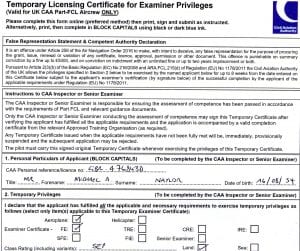
I am pleased to announce that I have passed the Assessment of Competence for the PPL Flight Examiner certificate. This means that I can now conduct LAPL(A) and PPL(A) skill tests, IMCR / IR(R) skill tests and LST / LPC tests for SEP rating issue / re-validation.