Category: News

Revalidating an SEP rating by experience

After the licensing review completed by the CAA in October 2025, revalidating a PPL  SEP rating by experience got easier, in one sense, but a little bit

more demanding in another.

Hours required

The old rules were 12 hours flight experience in the second year of validity of the 2 year rating – but bizarrely, none in the first year of validity.

The new requirement is still 12 hours total, but under the new rules these hours can be done over 2 years, which allows more flexibility and the opportunity to spread out the cost of flying. Specifically, the experience requirement over the 2 years is

  • 12 hours total time,
  • of which 6 hours PiC
  • including 12 take offs and landings as sole manipulator of the controls
  • a flight with an instructor of at least 1 hour

The new rules stipulate that at least 6 hours (not necessarily PiC) must be flown in the second year of rating validity, but the other requirements can be met at any time during the 2 years.

The biennial instructional flight

As guidance, the CAA have written GM2, AMC1 and AMC3  to FCL.740.A which can be found on their website here. The aim of the flight is to refresh little-practiced exercises, extend skills, and ensure that flying is safe and competent. There is a lengthy menu of potential topics and exercises  from which we can choose.

Exercises like stalls, steep turns , a practice forced landing and glide or flapless landings would normally be in the mix, as most pilots don’t practice them regularly. The CAA also expect TEM (threat and error management), the use of an MMD (moving map display) such as SkyDemon and partial power-loss scenarios to be covered. Some of these merit a thorough briefing. At my school, we typically do an hour of ground school before the flight itself, which may extend to more than an hour. The briefing often identifies gaps in knowledge, useful exercises, or indeed things the pilot avoids doing through lack of confidence. That’s all grist for the mill.

Other relevant tests

Previously, it was common practice to accept a pass in e.g. an IR or IMC rating revalidation test,  in lieu of the 1 hr SEP instructional flight. It is questionable whether this ever was permitted – the wording in according to the Regulations (FCL.740.A), perhaps badly drafted, suggested that it was not acceptable. To clarify things, the CAA have now stated that the 1 hr instructional flight CAN be combined with an IR or IMCR revalidation test BUT some elements of the SEP instructional flight must be included in that test.

Satisfactory standard

One much debated point is the need to achieve a satisfactory standard – without which the instructor should not sign off the rating revalidation page. In a TrainingCom sent to Instructors and Examiners, available here, the CAA defines ‘satisfactory standard’ as that to be expected during a PPL/LAPL skills test (LST). That has the status of guidance, but the CAA intend to issue further regulatory material as an AMC or GM later in 2026.

You may well ask how the instructional refresher flight differs from a test? In several ways, I think.

  • Firstly, a test is, in principle, a single attempt (pass / fail) for a comprehensive set of exercises without input from the examiner.  In the training flight, the exercises flown may – if necessary – be briefed beforehand, demo’d by the instructor and practiced by the candidate to achieve a satisfactory standard. Bear in mind, though, that a lot of demo and practice, will exceed the 1 hour minimum, but that’s fine – we can plan for that.
  • Secondly, the menu of exercises is not rigid. The flight will invariably comprise some essential safety-related exercises but the content should be tailored to the pilot’s experience, recency and needs. The context of the location may also be relevant. The need to fly accurate headings and altitudes, for example, is paramount in areas close to controlled airspace. Considerations for forced landings and partial power depend on the proximity to airfields and the nature of the landscape being flown over.
  • Thirdly, the flight is not necessarily a one-shot event. It is perfectly OK to do more than one flight and work with the pilot to improve his flying, if needed.
  • Fourthly, a successful test can be logged as PICUS (P1 under supervision). The biennial instruction flight is always logged as PUT.

And finally…..

The flight with an instructor is not (and never has been) a tick-box exercise. A short jolly to have lunch somewhere with your instructor mate won’t cut it. Think what you would like to cover to get best value for money.

PPL e-exams

The CAA introduced e-exams in October 2020. Full details can be found here: https://www.caa.co.uk/General-aviation/Pilot-licences/Training-organisations/PPL-e-exams/

What’s changed?

To access the exam system, you have to go through several steps.

  1. Register as a customer on the CAA portal – it’s free and you will use this for other things later, like applying for your medical and licence. Approval takes a few days, as they check your details and submitted documents (e.g. proof of address). If you’ve already applied for a Medical, you will have already registered and got a CAA reference number, which is yours for life. 
  2. Once approved, you then have to request the e-exam service. Approval for this may be instantaneous or again take a few days.
  3. When this is approved, you must select your Training Organisation on the portal (you can change this at any time), i.e. your flying school. The ATO gets your request and approves it. Only when you’ve done that can we ‘see’ you on the system. 
  4. Now you can request the exam you want on the portal. More usually, your instructor or exam invigilator does this on your behalf.
  5. You then take the exam at your ATO. They will provide a computer to do the test, overseen by an invigilator. You must phone the ATO office to book a slot for the exam, as only a few instructors are authorised to invigilate. 

There is more variety in questions – both in style or content – and a few new questions compared with the old paper exams. So more than ever, you need to ensure that you understand the subjects, don’t just learn for the purpose of passing the exam. In particular, there are scenario-based questions, which are used to test your ability to apply knowledge. Part of the art is to figure out what the underlying topic or question is, and to sift out the relevant info in the question from the potentially irrelevant.

What’s not changed?

  • The PPL theory syllabus is unchanged, and for convenience is published here https://www.caa.co.uk/General-aviation/Pilot-licences/Training-organisations/PPL-e-exams/
  • The exam software is clever enough to ensure that you get a reasonable mix of the different syllabus areas (so if you do AGK, you won’t get a test in which all the questions are on one topic e.g. instruments).
  • However, the syllabus does not provide practice questions  but you can access these through several online PPL courses with question banks.
  • You still take the exam at your flying school.
  • You can still take the exam at any time convenient to you and your flying school.

Why have the CAA done this?

  • Arguably e-exams are the modern way to do things, and it mirrors what has already happened with CPL / ATPL exams.
  • The paper exams had been around several years, and some needed updating.
  • The exam questions are more secure and there is greater rigour in e.g. exam timing and marking.
  • The CAA say they will refresh a certain percentage of the questions each year – keeping the questions current, topical and relevant in case new safety issues or priorities emerge.
  • You get an almost-instant result for the exam by email, or your invigilator can view it on the CAA ATO portal. The result report identifies deficiencies in your knowledge (referenced to the syllabus or learning objectives)  but you won’t be told which questions you got wrong.

The silent killer

The AAIB today published a special bulletin on the tragic crash of the Piper Malibu in which footballer Emiliano Sala and his pilot died. Sala’s toxicology revealed very high (potentially fatal) levels of carboxy-haemoglobin in the blood. The AAIB concluded that the pilot very likely suffered the same and are investigating how the CO (carbon monoxide) could have entered the cabin. The implication is that the loss of control was due to CO incapacitation.

CO is the silent killer – it is colourless and odourless. Low levels of CO cause drowsiness, headache and nausea; higher levels impair concentration and flying ability; very high levels cause unconsciousness, heart attack and death.

A leaking exhaust and/or defective cabin heater shroud round the exhaust can be the cause of CO entering the cockpit.  Our club aircraft all carry a CO detector. The simple spot detectors cost a few ££ and turn black within minutes when CO is present.  They have a limited life-span and their replacement is scheduled in a diary.

More sophisticated detectors, similar to domestic ones, are also available.
The AAIB report is a reminder of the importance of monitoring for carbon monoxide. How do you monitor CO in the cockpit?

Flight Examiner

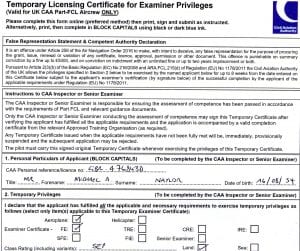
I am pleased to announce that I have passed the Assessment of Competence for the PPL Flight Examiner certificate. This means that I can now conduct LAPL(A) and PPL(A) skill tests, IMCR / IR(R) skill tests and LST / LPC tests for SEP rating issue / re-validation.

The UK IMC rating

PPL/IR Europe has published two papers of interest to instrument pilots. One is a position paper on the UK IMC rating, which PPL/IR strongly supports. PPL/IR is engaging with both the UK CAA and with EASA on the future of the IMC rating, and one possible successor, EASA’s Basic Instrument Rating (BIR). The other is the result of a survey of holders of the IMC rating. The survey demonstrates that the IMC rating is a valuable development step for pilots, and greatly increases the utility of a PPL when dealing with the vagaries of British weather. There is a wide variation in  how the IMC rating is used, from occasional use to transit en route IMC, to deliberate departure and arrival in IMC conditions.


8.33 confusion

Clubs and owners have spent serious money installing 8.33 radios and ground stations are gradually changing over. Often the new frequency is very close to the old one, but not always! This could create confusion as I discovered on a recent flight, when I failed to raise Oxford on any of the frequencies printed by Skydemon. A quick call to London Information put me right. I later realized that Skydemon had published the 8.33 frequencies 4 days early. To my shame, there was a NOTAM stating that up until the changeover date, one should use a (totally) different frequency. But in my defence, the NOTAM wording was a bit unclear.

So what tips can I offer to avoid the confusion?

  1. Look at AIP supplement 014/2018, which lists aerodromes that have converted and those which will convert in the next 30 days. The CAA will issue updates with new Supplement numbers, which can be found in the Index.
  2. Read the frequencies which Skydemon prints, but then….
  3. Read the NOTAMS carefully
  4. Read CAP1606. Gliding and micro-light frequencies will remain on 25 kHz spacing until Dec 2018 (after which they will change). The international D&D frequency 121.5 will be unchanged.

Happy flying!

Cessna wing strut AD

The US FAA are proposing an Airworthiness Directive (AD) for all Cessna C172, C182, C206, C207 and C210 aircraft manufactured before 1995, including the Reims variants. The AD addresses reports of cracking near the forward cabin doorpost, at the lower wing strut attachment. The cracks are the result of metal fatigue, according to the AD, and could result in the wing strut attach point failing in-flight.

The concerns have existed for 20 years+ and the AD mandates compliance with existing Cessna Service Bulletins SEB-95-19 and SEB-93-5R1, which both date back to 1995.

If adopted as written, the first inspection is due at 4,000hr and will take about 1.5hr to accomplish. It must then be repeated annually or every 1,000hr, whichever comes first. If cracks are found, the repair consists of installing a Cessna service kit to reinforce the area, which is estimated to take about 24 man-hours, at an estimate cost of $2,500-$3,000.

FAA ADs are usually adopted by EASA, so the AD would apply to all EU registered affected aircraft.

Hello pilots

I am pleased to announce the formal launch of my website https://aiminghigher.aero/

This aims to showcase some of the training I can offer. It will also feature destinations to inspire you with places to go, and provide a one-stop shop for planning links (weather, NOTAM’s etc) and tools like an easy-to-use PLOG. For those attending ground school classes, the website will be the source of the handout and additional reference material.

This is a work in progress, so if there is something you would like to see added or improved, please let me know.