
 The CAA introduced e-exams in October 2020. Full details can be found here: https://www.caa.co.uk/General-aviation/Pilot-licences/Training-organisations/PPL-e-exams/
Key messages
- You still sit the exams at your ATO / DTO
- You can’t just just breeze in and sit an exam spontaneously!
- You first need to complete a series of registration steps, each of which requires automated or manual approval, before your first first exam. This can take several days to a week.
- Only a small number of ATO staff, usually instructors, are authorised to invigilate the exam. So you need to book a few days ahead.
- You need to provide proof that you are ready for test. Online courses provide a course completion certificate per subject. Failing that you can present your practice paper scores, or the invigilator can informally quiz you to assess your knowledge is sufficient.
What’s the registration process?
- Register as a customer on the CAA portal – it’s free and you will use this for other things later, like applying for your medical and licence. Approval takes a few days, as the CAA check your details and submitted documents (e.g. proof of address). If you’ve already applied for a Medical, you will have already registered and got a CAA reference number, which is yours for life.
- Once approved to use the portal, you have to request the e-exam service. Approval may be instantaneous or again take a few days.
- You then select your Training Organisation on the portal (you can change this at any time), i.e. your flying school. The ATO gets your request and approves it. Only a handful of people at each ATO hold approval privileges – so there can be a delay if the person(s) required are out of office. Only when you’ve done that can the ATO ‘see’ you on the system.
- The CAA will verify your exam history (or the absence thereof) before a booking can be made. This is a manual process which can take a few days.
- Now you can book an exam. More usually, the ATO or your instructor may do so on your behalf.
- You then take the exam at your ATO. They will provide a computer to do the test, overseen by an invigilator. You must phone the ATO office to book a slot for the exam, to ensure that an invigilator is available.
What’s new?
There is more variety in questions – both in style and content – and a few new questions compared with the old paper exams. So more than ever, you need to ensure that you understand the topics, don’t just learn for the purpose of passing the exam. In particular, there are scenario-based questions, which are used to test your ability to apply knowledge. Part of the art is to figure out what the underlying question is, and to sift out the relevant info in the question from the potentially irrelevant. The exam software is clever enough to ensure that you get a reasonable mix of the different syllabus areas (so if in AGK, for example, you won’t get a test in which all the questions are on one topic such as Instruments).
What’s not changed?
- The PPL theory syllabus is unchanged, and for convenience is published here https://www.caa.co.uk/General-aviation/Pilot-licences/Training-organisations/PPL-e-exams/
- The syllabus does not provide practice questions but you can access these through several online PPL courses with question banks.
- You still take the exam at your flying school.
- You can still take the exam at any time convenient to you and your flying school.
- The need to provide the ATO with proof you’re ready for test has existed for some years, but is now a formal requirement.
Why have the CAA done this?
- Arguably e-exams are the modern way to do things, and it mirrors what has already happened with CPL / ATPL exams.
- The paper exams had been around several years, and some needed updating.
- The exam questions are more secure and there is greater rigour in e.g. exam timing and marking.
- The CAA say they will refresh a certain percentage of the questions each year – keeping the questions current, topical and relevant in case new safety issues or priorities emerge.
- You get an almost-instant result for the exam by email, or your invigilator can view it on the CAA ATO portal. The result report identifies deficiencies in your knowledge (referenced to the syllabus or learning objectives) but you won’t be told which specific questions you got wrong.


 First a confession. I am a big fan of the flight navigation (dead reckoning) computer, a.k.a. the whizz wheel. Sure, it takes a little investment to learn how to use it, but once over that hurdle, it is fast and accurate.
 Here’s the solution which several flying schools offer…. Buy Sportys E6B app for your phone and practice with that. It will cost under $10 on Android and a bit more if you insist on using an iPhone or iPad. For the real exam, borrow a Sporty’s E6B electronic computer from your friendly and helpful instructor. The user interface is well-nigh identical. Job done!
 Back in the spring, I was doing Flight Examiner training with our CFI. One of the training exercises is to conduct an LPC (Licence Proficiency Check) on a lapsed pilot returning to flying. You know how some comedians are excellent mimics? Well our CFI can mimic the rusty or inept pilot to a T. She demonstrated more bad habits in 30 mins than I have seen in several years of biannual instruction flights. For example….
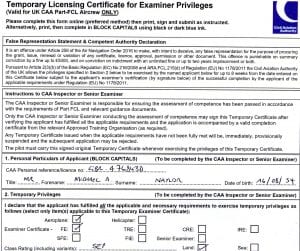 I am pleased to announce that I have passed the Assessment of Competence for the PPL Flight Examiner certificate. This means that I can now conduct LAPL(A) and PPL(A) skill tests, IMCR / IR(R) skill tests and LST / LPC tests for SEP rating issue / re-validation.